Vasculearn Network · Clinical Hub
Atrial Fibrillation (AF)
Printed November 14, 2026 · vln.org/hcp/disease-state/atrial-fibrillation
Clinical Overview
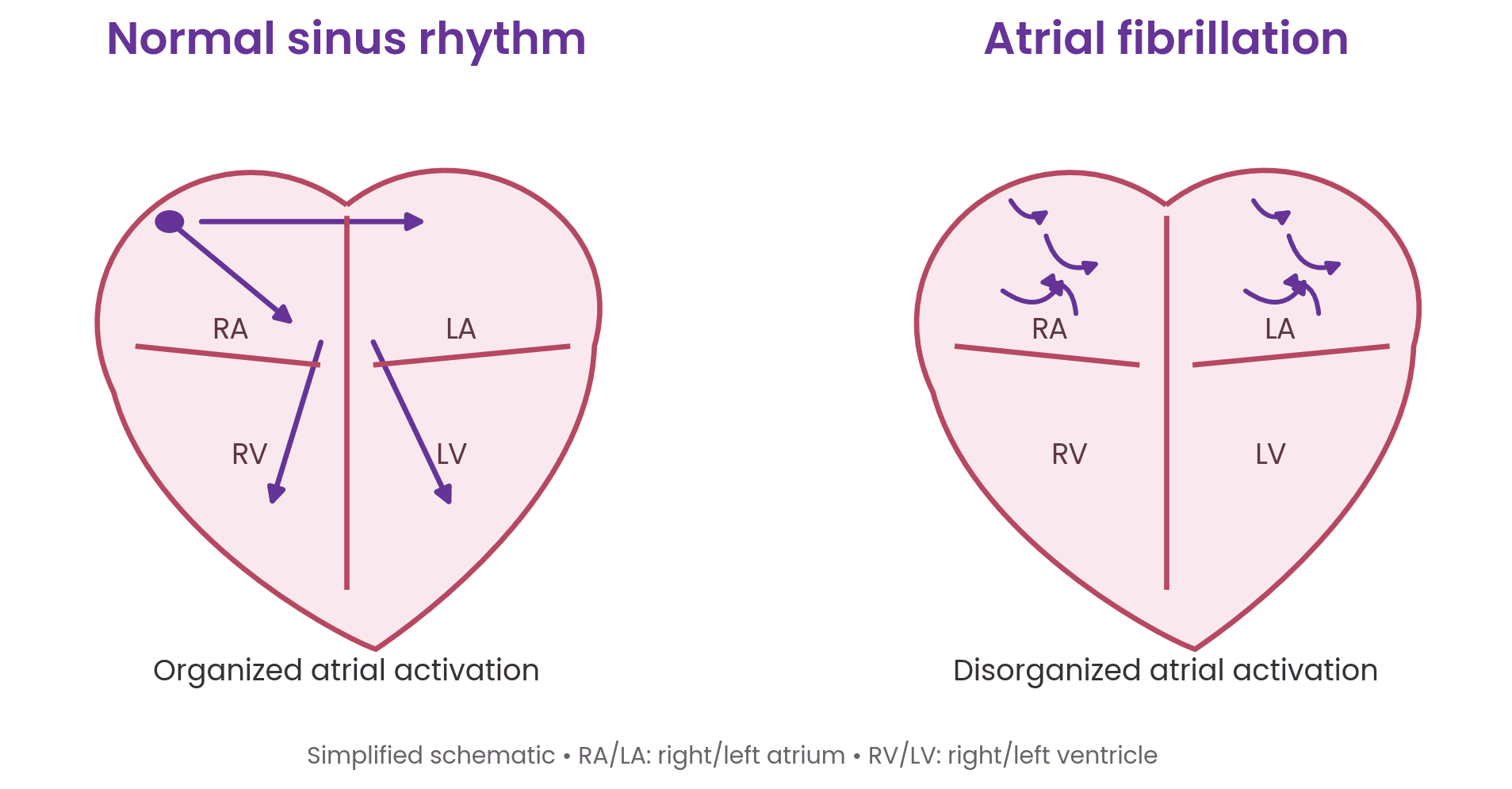
AF is a common arrhythmia that increases stroke risk and can affect cardiac function and quality of life. In AF, disorganized atrial electrical activity impairs coordinated contraction, allowing blood to pool and form clots that can travel to the brain. A rapid ventricular response can impair cardiac function. Hypertension, obesity, sleep apnea, and other conditions can promote atrial remodeling and AF progression.
AF may cause palpitations, fatigue, or declining exercise tolerance—or first emerge during a stroke or heart failure (HF) admission. More than 10.5 million U.S. adults have AF; symptoms alone do not indicate risk.
AF management connects daily function with prevention of future harm:
- Assess stroke risk independently of symptoms
- Discuss rhythm control early when appropriate
- Address conditions driving AF
The plan should reflect the patient’s goals and what they can sustain.
Diagnosis
Confirm and characterize AF
- ECG confirmation:
- Confirm AF by visually reviewing a 12-lead ECG or rhythm-device recording.
- An irregular pulse or optical smartwatch alert alone does not confirm AF.
- Intermittent episodes:
- Match monitoring duration to symptom frequency; consider extended monitoring after unexplained stroke or systemic embolism.
AF pattern | Definition |
|---|---|
Paroxysmal | Terminates within 7 days. |
Persistent | Continuous for >7 days. |
Long-standing persistent | Continuous for >12 months. |
Permanent | Shared decision to stop further rhythm-control attempts. |
Assess stability and underlying disease
- Urgent care: AF-related instability requires immediate synchronized cardioversion. New focal neurologic symptoms require emergency stroke assessment.
- Initial evaluation:
- Review onset, symptoms, medications, alcohol, and comorbidities.
- Obtain echocardiography, a complete blood count, metabolic panel, and thyroid testing; assess ventricular function, valves, renal function, and electrolytes.
Device-detected episodes
Confirm atrial high-rate episodes and duration. Without prior clinical AF, U.S. guidance supports considering anticoagulation through shared decisions for episodes ≥24 hours with CHA₂DS₂-VASc ≥2, or 5 minutes to <24 hours with score ≥3. Episodes <5 minutes alone do not warrant anticoagulation.
AF during illness or surgery can recur; arrange follow-up and stroke-risk reassessment. During critical illness due to sepsis, benefit from anticoagulation for AF stroke prevention is uncertain.
Treatment
Prevent stroke according to risk
The 2023 ACC/AHA/ACCP/HRS AF Guideline supports validated stroke-risk assessment such as CHA₂DS₂-VASc. The ACC CardioSmart AFib Stroke and Bleeding Risk Calculator can support discussions. Reassess at least annually and after clinical changes, regardless of AF pattern or apparent rhythm-control success.
Clinical AF stroke risk | U.S. anticoagulation approach |
|---|---|
≥2% annually | Recommended; typically CHA₂DS₂-VASc ≥2 in men or ≥3 in women. |
≥1% to <2% annually | Reasonable; typically score 1 in men or 2 in women. Discuss additional risk modifiers. |
Female sex alone is not an indication. The 2024 ESC AF Guidelines use CHA₂DS₂-VA; follow the selected framework’s thresholds.
Anticoagulant selection and safety
Direct oral anticoagulants (DOACs) are guideline-recommended over warfarin for eligible patients. Selection considers bleeding history, renal function, interactions, dosing preferences, and cost. Observational comparisons associate apixaban with less gastrointestinal (GI) bleeding than other DOACs and less major bleeding than rivaroxaban; head-to-head randomized evidence is lacking.
Warfarin remains standard for mechanical valves or moderate-or-greater mitral stenosis and appropriate when DOAC cost prevents sustained treatment. Patients may continue well-managed warfarin after discussing tradeoffs. Consider INR access, monitoring costs, interactions, and time in therapeutic range; the usual AF target is INR 2–3.
- Use labeled dosing:
- Use renal function, age, weight, and interaction criteria. Avoid unsupported dose reductions; advanced kidney disease requires individualized selection.
- Address bleeding risks:
- Address uncontrolled blood pressure, unnecessary antiplatelets/NSAIDs, alcohol, and bleeding sources. A bleeding score alone should not exclude anticoagulation.
- Review aspirin:
- Aspirin does not substitute for anticoagulation.
- Beyond 1 year after coronary revascularization, without prior stent thrombosis, anticoagulant monotherapy is generally recommended. Recent ACS/PCI needs a separate plan.
Consider left atrial appendage occlusion
Percutaneous LAAO is an alternative for selected patients with nonvalvular AF. The 2023 ACC/AHA/ACCP/HRS AF Guideline supports it for moderate-to-high stroke risk with a nonreversible contraindication to long-term anticoagulation. It may also be considered for high bleeding risk, weighing procedural risk against the more extensive anticoagulation evidence. Treatable bleeding does not automatically preclude anticoagulation.
The 2025 SCAI/HRS Transcatheter LAAO Guidelines conditionally support anticoagulation or LAAO, considering bleeding history, elevated bleeding risk, and strong patient preference to avoid long-term anticoagulation. Selection includes anatomy, frailty, expected benefit, and follow-up capacity; LAAO may be inappropriate with less than 1 year of quality life expectancy.
Discuss procedural bleeding, pericardial effusion, and stroke alongside long-term benefits. Postimplant anticoagulation or dual antiplatelet therapy and imaging remain necessary; device-related thrombus may require anticoagulation, and residual leak management remains uncertain. LAAO does not treat AF or remove other anticoagulation indications. Surgical appendage exclusion generally supplements indicated anticoagulation; benefit without continued anticoagulation is uncertain.
Select rate and rhythm control
Discuss early rhythm control, especially within the first year or with symptoms or HF. Rate control may accompany rhythm control or serve as the main strategy, according to clinical circumstances and patient preferences.
Approach | Selection and monitoring |
|---|---|
Rate control | Beta-blockers or diltiazem/verapamil; avoid the latter with LVEF <40%. Digoxin is useful in selected patients. Without heart failure, a symptom-guided resting target generally <100–110 beats/min is reasonable. |
Rhythm-control drugs | Choose by ventricular function, prior MI, structural disease, QT interval, renal function, and interactions. Avoid flecainide/propafenone with prior MI or significant structural disease. Dofetilide requires monitored initiation; amiodarone requires toxicity monitoring. |
Catheter ablation | Useful when rhythm drugs fail, are unsuitable, or are not preferred; first-line in selected patients. In appropriate patients with HFrEF, ablation improves symptoms and cardiovascular outcomes. |
Plan anticoagulation around procedures
- Cardioversion:
- For AF ≥48 hours or uncertain duration, use ≥3 weeks of therapeutic anticoagulation or imaging to exclude thrombus beforehand.
- Continue anticoagulation ≥4 weeks afterward, then according to stroke risk. Shorter-duration AF still requires risk assessment.
- Catheter ablation:
- Use uninterrupted warfarin or continuous/minimally interrupted DOAC therapy.
- Continue anticoagulation ≥3 months afterward under U.S. guidance, then according to stroke risk.
- Other procedures:
- Plan interruption and restart by agent, renal function, bleeding risk, and hemostasis. Most patients do not need heparin bridging; mechanical valves or recent stroke/TIA require separate assessment.
- Patient planning:
- The VLN Procedure Playbook includes guidance, calendars, and worksheets for a clinician-approved stop/restart plan around scheduled procedures.
Follow-up
Assign responsibility for symptoms, rate/rhythm, renal function, anticoagulant safety, and refills. Provide clear interruption and restart instructions.
Prevention
Build prevention into the patient’s care
Prevention starts before AF diagnosis and continues afterward. Blood pressure, metabolic health, sleep, activity, and alcohol exposure influence the atrial substrate and overlap with other care goals. Connect these priorities to what matters to the patient—stamina, sleep, independence, or fewer symptomatic episodes.
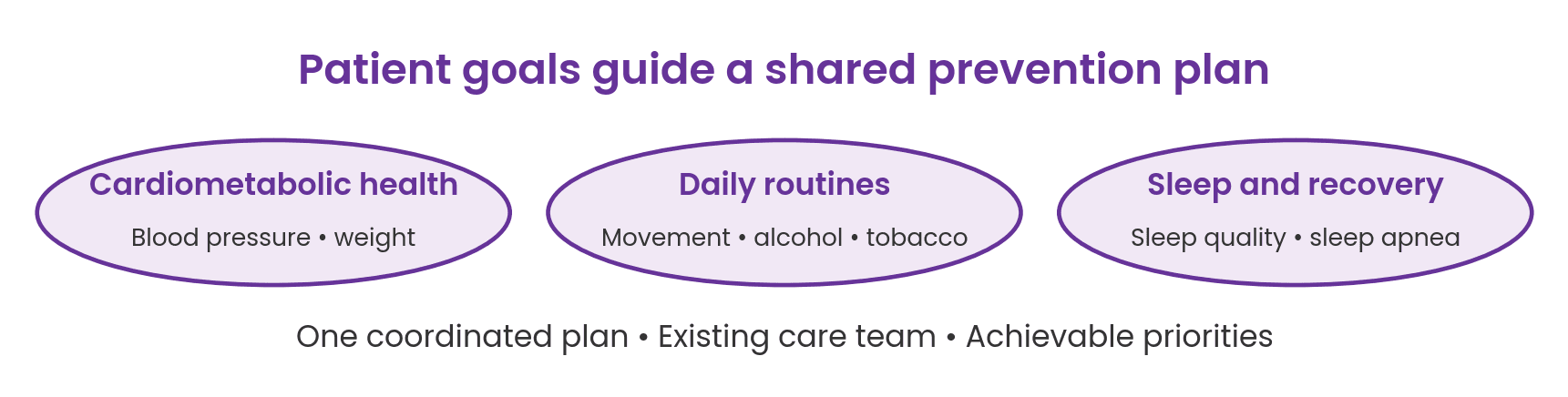
Agree on one or two achievable priorities. Build on existing care, share follow-up responsibility, and revisit progress and barriers during routine visits to reduce fragmented referrals and repeated counseling.
For patients with AF, guideline targets support gradual progress: sustained weight loss, ideally ≥10% when BMI >27 kg/m², and 210 minutes/week of moderate-to-vigorous activity adapted to capacity. Less alcohol and smoking cessation also support care. Sleep apnea treatment has broader benefits; its effect on maintaining sinus rhythm remains uncertain.
Health Equity
Make the care plan sustainable
- Medication access:
- Check coverage and costs; coordinate refills and reliable INR monitoring when warfarin is used.
- Communication:
- Use interpreters and teach-back; distinguish anticoagulation from rate/rhythm treatment.
- Share ACC CardioSmart AF patient education and action plans and AHA AF patient resources.
- Monitoring and referrals:
- Offer monitoring without a smartphone, consistent referral criteria, and flexible follow-up.
- Care gaps:
- Review anticoagulation, dosing, referrals, and follow-up across language, insurance, sex, race/ethnicity, and geography when data permit.
Acronyms & Glossary
Term | Meaning |
|---|---|
ACC / AHA | American College of Cardiology / American Heart Association |
ACCP / HRS | American College of Clinical Pharmacy / Heart Rhythm Society |
ACS / PCI | Acute coronary syndrome / percutaneous coronary intervention |
AF / AHRE | Atrial fibrillation / atrial high-rate episode |
BMI | Body mass index |
Stroke-risk score: heart failure, hypertension, age ≥75 (2 points), diabetes, stroke/TIA/thromboembolism (2 points), vascular disease, age 65–74, and female sex | |
ESC stroke-risk score omitting sex | |
DOAC | Direct oral anticoagulant |
ECG | Electrocardiogram |
ESC / SCAI | European Society of Cardiology / Society for Cardiovascular Angiography & Interventions |
HFrEF / LVEF | Heart failure with reduced ejection fraction / left ventricular ejection fraction |
INR | International normalized ratio; monitors warfarin |
LAAO | Left atrial appendage occlusion |
MI / NSAID | Myocardial infarction / nonsteroidal anti-inflammatory drug |
Sinus rhythm | Rhythm originating from the sinus node |
TIA | Transient ischemic attack |
Resources & References
Clinical tools and patient education
VLN Procedure Playbook — a guide for patients preparing for a procedure