Vasculearn Network · Clinical Hub
Hypertension
Printed November 14, 2026 · vln.org/hcp/disease-state/hypertension
Clinical Overview
Hypertension (HTN) affects nearly half of U.S. adults, though less than 25% have well-controlled blood pressure (BP). Risk reflects cumulative BP exposure and extends beyond stroke and coronary disease to heart failure (HF), chronic kidney disease (CKD), and cognitive impairment. Assessment should establish the BP phenotype, cardiovascular risk, and organ injury, not rely on symptoms.
- Confirm the phenotype: White-coat and masked hypertension can change treatment decisions; use out-of-office readings to clarify the pattern.
- Look for secondary disease: Abrupt onset or worsening, resistant HTN, hypokalemia, or disproportionate organ injury warrant targeted evaluation.
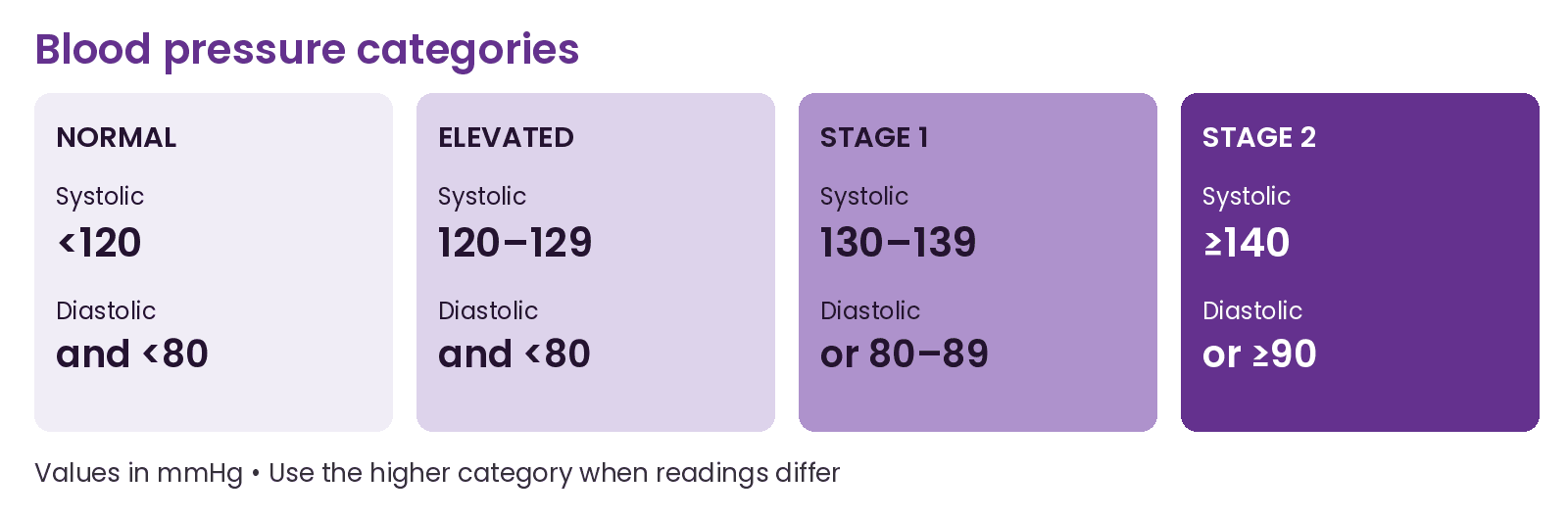
Use the higher category when systolic blood pressure (SBP) and diastolic blood pressure (DBP) differ. These are U.S. office categories; home blood pressure monitoring (HBPM) and ambulatory blood pressure monitoring (ABPM) require method-specific thresholds.
Diagnosis
Measure BP Accurately
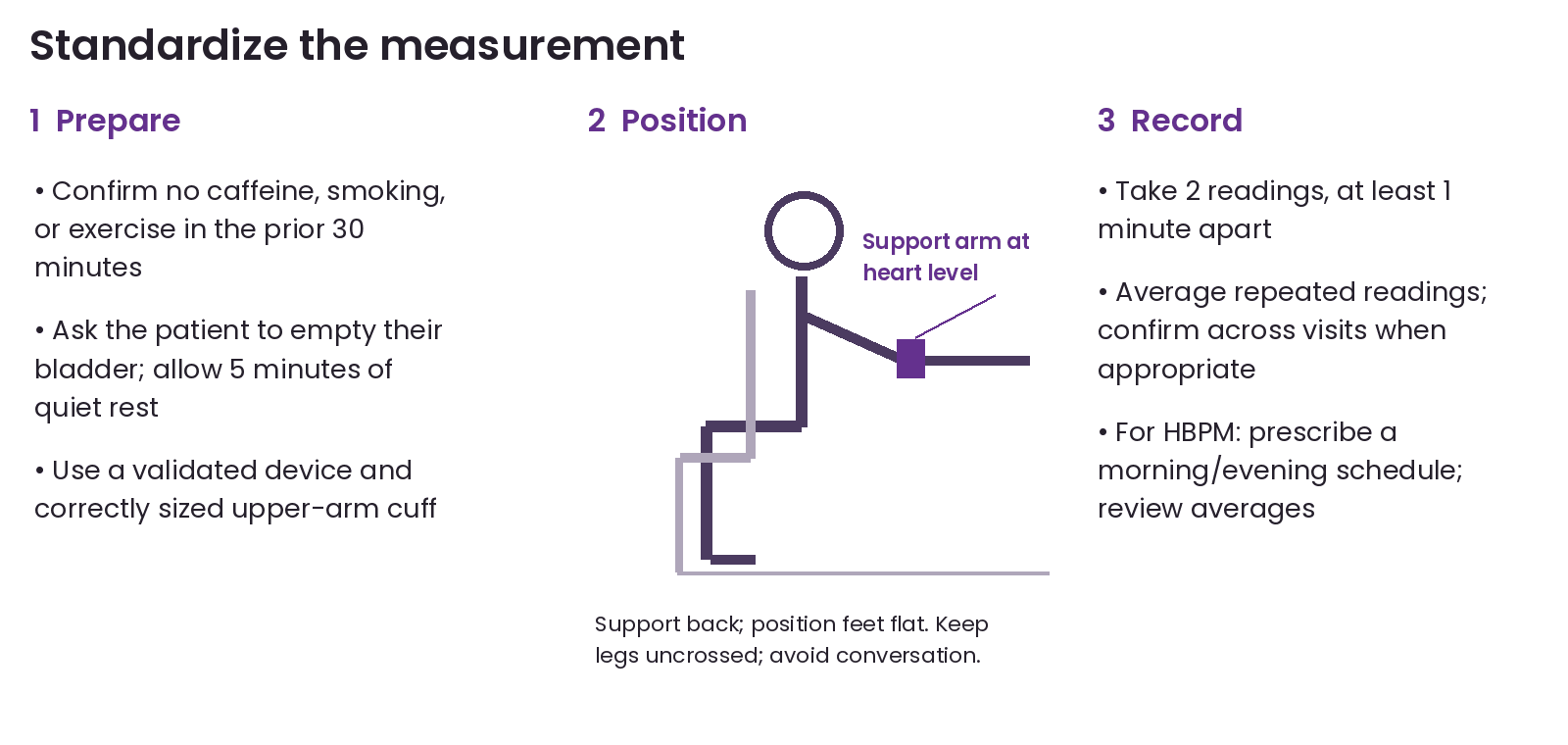
Home monitoring
Use the American Heart Association (AHA) Home Blood Pressure Monitoring instructions to teach patients proper technique. Cuffless wearables should not determine diagnosis or medication titration.
- Use HBPM or ABPM to confirm sustained elevation and identify white-coat or masked patterns; ABPM also evaluates nighttime BP.
- Discordant readings: Recheck cuff fit, technique, timing, and recording adequacy. Measure orthostatic BP when symptoms or clinical risk warrant it.
Assess risk and secondary causes
- Baseline evaluation: Review cardiovascular disease (CVD), stroke, diabetes, CKD, pregnancy potential, and all medications. Obtain renal function, electrolytes, metabolic testing, urinalysis, urine albumin-to-creatinine ratio (UACR), and electrocardiogram (ECG).
- Predicting Risk of Cardiovascular Disease Events (PREVENT): For eligible adults without established CVD, use the PREVENT calculator’s 10-year total CVD estimate for stage 1 treatment decisions. Note that PREVENT atherosclerotic cardiovascular disease (PREVENT-ASCVD) is the estimate used for lipid decisions.
- Secondary causes: Evaluate clinical clues to primary aldosteronism, obstructive sleep apnea (OSA), renal disease, and other endocrine causes. Review use of nonsteroidal anti-inflammatory drugs (NSAIDs), stimulants, decongestants, glucocorticoids, and hormonal agents.
- Primary aldosteronism: Screen resistant HTN even without hypokalemia. Interpret aldosterone, renin, and the adosterone-to-renin ratio (ARR) in the context of potassium and interfering medications.Treatment
Treatment
Thresholds and targets
- Start medication: Average SBP ≥140 or DBP ≥90 mmHg; or SBP ≥130 or DBP ≥80 mmHg with CVD, prior stroke, diabetes, CKD, or PREVENT 10-year total CVD risk ≥7.5%.
- Lower-risk stage 1 HTN: Add medication if BP remains ≥130/80 mmHg after 3–6 months of lifestyle intervention.
- Target: Generally <130/80 mmHg, with encouragement toward SBP <120 mmHg when appropriate and tolerated, particularly with increased CVD risk. Individualize for frailty, limited life expectancy, institutional care, and tolerability; pregnancy and acute stroke require separate guidance.
Select and combine first-line agents
The second and third agents usually come from the same first-line classes; comorbidities and tolerability determine the combination.
- Stage 1 requiring medication: Usually start one first-line agent.
- Stage 2: Start two complementary first-line agents, preferably in a single pill: an angiotensin-converting enzyme inhibitor (ACE inhibitor) or angiotensin II receptor blocker (ARB) plus a long-acting dihydropyridine calcium channel blocker (CCB) or thiazide-type diuretic.
Class and examples | Selection and monitoring |
|---|---|
ACE inhibitor / ARB | Favor for albuminuric CKD. Monitor creatinine/estimated glomerular filtration rate (eGFR) and potassium. Use an ARB for ACE inhibitor cough. Avoid in pregnancy and do not combine the two classes. |
Dihydropyridine CCB | Useful alone or in combination. Peripheral edema may limit dosing; routine electrolyte monitoring is not required. Diltiazem and verapamil have different cardiac effects. |
Thiazide-type diuretic | Monitor sodium, potassium, renal function, and gout risk. In resistant HTN, optimize diuretic dosing; a thiazide-like agent may improve control. |
Second and third agents
- Above goal: Confirm home averages, adherence, tolerability, and effective dosing; add a complementary class. A usual three-drug foundation is an ACE inhibitor or ARB + dihydropyridine CCB + diuretic.
- Follow-up: Reassess generally monthly until controlled, using home averages and class-specific renal function and electrolyte monitoring.
Resistant hypertension
BP above goal on three complementary drugs, including a diuretic at maximally tolerated doses—or control requiring four or more—suggests resistant HTN. Exclude measurement error, white-coat effect, nonadherence, and interfering substances before escalation.
- Preferred fourth drug when appropriate: Spironolactone, a mineralocorticoid receptor antagonist (MRA). Assess eGFR and potassium before and after initiation or titration; hyperkalemia or significant kidney dysfunction may preclude use.
- Further options: Seek specialist evaluation of secondary causes and individualized add-ons. Beta-blockers, alpha-blockers, central agents, and direct vasodilators have distinct indications and adverse effects.
- Aprocitentan: An add-on option for adults inadequately controlled on other drugs. Monitor fluid retention, anemia, and liver function; it is contraindicated in pregnancy.
- Renal denervation (RDN): An adjunct for selected patients after confirmation of uncontrolled HTN and optimization of care; refer for specialist evaluation.
Comorbidities can change drug selection
- Albuminuric CKD: Favor an ACE inhibitor or ARB for kidney protection when indicated; diabetes alone does not require these classes.
- HF with reduced ejection fraction (HFrEF): Prioritize outcome-directed therapy: an angiotensin receptor–neprilysin inhibitor (ARNI) or ACE inhibitor/ARB, an evidence-based beta-blocker, MRA, and sodium-glucose cotransporter-2 inhibitor (SGLT2 inhibitor) as appropriate. Avoid nondihydropyridine CCBs.
- Angina, selected settings after myocardial infarction (MI), or rate control: A beta-blocker may be indicated earlier; it is not routine first-line therapy for uncomplicated HTN.
- Pregnancy or pregnancy planning: Use pregnancy-specific thresholds and drug selection; ACE inhibitors and ARBs are contraindicated in pregnancy.
Severe hypertension and acute organ injury
- Acute target-organ injury: Requires monitored hospital management, often intravenous (IV) therapy. The affected organ and clinical syndrome determine the BP-lowering strategy.
- Without acute injury: Nonpregnant adults with SBP >180 or DBP >120 mmHg generally need timely oral therapy adjustment and follow-up. Avoid reflex rapid lowering of isolated asymptomatic inpatient readings.
Prevention
Prescribe measurable lifestyle interventions
Use lifestyle treatment across BP categories and alongside medication. Agree on specific goals, review progress with BP trends, and intensify support when the plan is not feasible.
- Diet and sodium: Use the Dietary Approaches to Stop Hypertension (DASH) eating plan. Target sodium <2,300 mg/day, moving toward 1,500 mg/day; focus on packaged and restaurant foods. Adapt food choices to preferences, budget, and available preparation facilities.
- Potassium: Favor potassium-rich foods when appropriate. Before recommending supplements or potassium-based salt substitutes, assess CKD, potassium levels, and medications that increase hyperkalemia risk.
- Weight and activity: For overweight or obesity, aim for at least 5% weight loss. Prescribe ≥150 minutes/week of moderate or ≥75 minutes/week of vigorous aerobic activity, plus resistance exercise; adapt to functional capacity.
- Alcohol and sleep: Recommend reducing or eliminating alcohol. Assess OSA when suggested by symptoms or resistant HTN; address sleep disruption and stress as part of the care plan.
- Total vascular risk: Address tobacco use, dyslipidemia, and diabetes alongside BP. Lifestyle counseling should not delay medication when treatment thresholds are met.
Health Equity
Match the care plan to access and circumstances
Uncontrolled BP can reflect cost, access, communication, and competing needs. Identify the barrier before labeling a patient nonadherent; pair the treatment decision with a practical response.
- Make monitoring accessible: Arrange a validated device and suitable cuff through coverage or a loan program. Confirm technique by demonstration; accept the AHA Blood Pressure Log or telephone reporting when digital access is limited.
- Make treatment sustainable: Ask about cost, refill access, transport, and work schedules. Use affordable once-daily regimens or single-pill combinations when covered; coordinate refills and delivery where available.
- Support understanding and follow-up: Use qualified interpreters and teach-back. Agree on how readings will reach the team, who will respond, and when BP and safety labs will be reviewed; offer flexible visit formats.
- Extend the care team: Use nurse/pharmacist titration protocols and community health workers for navigation, food-access referrals, and follow-up. Centers for Disease Control and Prevention (CDC) Team-Based Care guidance supports implementation.
- Measure where care falls short: Track control, intensification, missed follow-up, and device access by race/ethnicity, language, insurance, or geography when data permit. Use gaps to target resources and reassess results.
Acronyms & Glossary
Term | Meaning |
|---|---|
ABPM | Ambulatory blood pressure monitoring |
ACC / AHA | American College of Cardiology / American Heart Association |
ACE inhibitor | Angiotensin-converting enzyme inhibitor |
ARB | Angiotensin II receptor blocker |
ARNI | Angiotensin receptor–neprilysin inhibitor |
ARR | Aldosterone-to-renin ratio |
BP / SBP / DBP | Blood pressure / systolic BP / diastolic BP |
CCB | Calcium channel blocker |
CKD / eGFR | Chronic kidney disease / estimated glomerular filtration rate |
CVD | Cardiovascular disease |
CDC | Centers for Disease Control and Prevention |
HFSA | Heart Failure Society of America |
NHLBI | National Heart, Lung, and Blood Institute |
DASH | Dietary Approaches to Stop Hypertension |
ECG | Electrocardiogram |
HBPM | Home blood pressure monitoring |
HTN | Hypertension |
HFrEF | Heart failure with reduced ejection fraction |
IV | Intravenous |
MI | Myocardial infarction |
mmHg | Millimeters of mercury |
MRA | Mineralocorticoid receptor antagonist |
NSAID | Nonsteroidal anti-inflammatory drug |
OSA | Obstructive sleep apnea |
PREVENT / PREVENT-ASCVD | Predicting Risk of Cardiovascular Disease Events / its atherosclerotic CVD risk estimate |
RDN | Renal denervation |
SGLT2 inhibitor | Sodium-glucose cotransporter-2 inhibitor |
UACR | Urine albumin-to-creatinine ratio |
White-coat / masked hypertension | Office BP above threshold with out-of-office BP below it / the reverse pattern |