Vasculearn Network · Clinical Hub
Stroke and Transient Ischemic Attack (TIA)
Printed November 14, 2026 · vln.org/hcp/disease-state/stroke-and-tia
Clinical Overview
Stroke can turn an ordinary moment into a loss of speech, movement, vision, or independence. Rapid recognition can preserve brain function; identifying the cause then shapes how to prevent the next event. A TIA deserves the same urgency, even when the patient feels back to normal.
Ischemic stroke results from blocked blood flow; hemorrhagic stroke results from bleeding within or around the brain. TIA is transient focal ischemic dysfunction without acute infarction. Symptoms that resolve but leave an acute infarct represent ischemic stroke, not TIA.
- Recognize and act: Sudden focal symptoms require emergency assessment. Record last known well and activate the stroke pathway; symptom improvement is not reassurance.
- Match treatment to the cause: Reperfusion, antiplatelets, anticoagulation, and procedures have different roles. The mechanism matters as much as the initial deficit.
- Plan for life after stroke: Prevention and recovery work together. Address function, mood, cognition, caregiver support, and access alongside vascular risk.
Diagnosis
Recognize the presentation and image promptly
- Initial assessment: Assess airway, breathing, circulation, bedside glucose, last known well, baseline function, and antithrombotic exposure. Use the NIH Stroke Scale (NIHSS), while recognizing that low scores can conceal disabling aphasia or posterior-circulation deficits.
- Clinical clues: Abrupt weakness, sensory loss, aphasia, or visual loss suggests focal ischemia. Diplopia, ataxia, or acute vestibular symptoms may signal posterior stroke. Thunderclap headache requires urgent assessment for subarachnoid hemorrhage (SAH).
Study | Purpose |
|---|---|
Noncontrast head CT | Rapidly exclude hemorrhage. A normal scan does not exclude early ischemia or TIA. |
CTA or MRA of head and neck | Identify large-vessel occlusion, stenosis, or dissection; obtain promptly when thrombectomy is being considered. |
MRI with diffusion-weighted imaging | Detect acute infarction; preferred for suspected TIA, ideally within 24 hours. Do not delay eligible reperfusion for MRI. |
Evaluate TIA and possible mimics
Use the 2023 AHA TIA Scientific Statement to guide urgent brain and vascular imaging, ECG, laboratory assessment, and disposition. The ABCD² score can inform risk assessment but cannot diagnose TIA or independently justify discharge. Recurrent symptoms, infarction, significant stenosis, or inability to complete rapid follow-up favor observation or admission.
Hypoglycemia, seizure with postictal deficits, migraine aura, and functional neurologic symptoms can mimic stroke. Persistent concern requires the stroke pathway and specialist assessment. Arrange cardiac monitoring and selective echocardiography; extend rhythm monitoring when no cause is found.
Classify the mechanism
Ischemic stroke is commonly classified using the five TOAST categories below. Large-artery and small-vessel disease are noncardioembolic; other and undetermined causes require further assessment rather than automatic assignment to AF-related treatment.
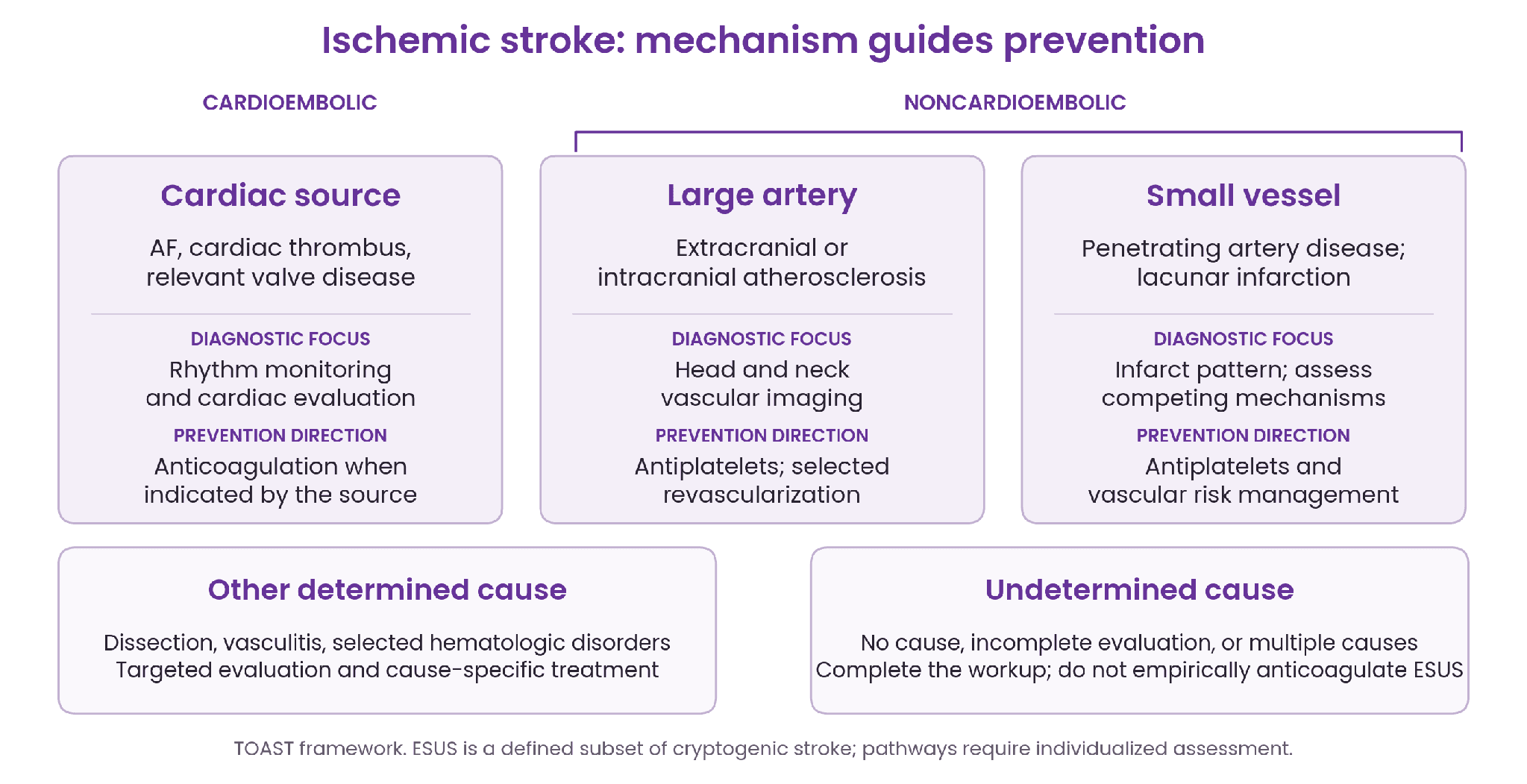
- Cardioembolic: Look for AF, intracardiac thrombus, relevant valve disease, or another high-risk cardiac source. AF is common, but not every cardiac source has the same antithrombotic treatment.
- Noncardioembolic: Large-artery atherosclerosis and small-vessel/lacunar disease generally lead to antiplatelet-based prevention. Vascular imaging distinguishes extracranial from intracranial disease and identifies potential procedural targets.
- Other determined: Consider dissection, vasculitis, and selected hematologic disorders according to age, imaging, and clinical context. Avoid indiscriminate thrombophilia testing; treatment is cause-specific.
- Undetermined: Cryptogenic stroke has no identified cause after evaluation. ESUS is a defined subset with a nonlacunar infarct and no major-risk cardiac source or relevant ≥50% arterial stenosis after a minimum diagnostic workup; it is not synonymous with all cryptogenic stroke.
For hemorrhagic stroke, distinguish intracerebral hemorrhage (ICH) from SAH. Investigate hypertensive arteriopathy, cerebral amyloid angiopathy, antithrombotic exposure, vascular malformations, or aneurysm as appropriate.
Treatment
Select acute ischemic stroke treatment
The 2026 AHA/ASA Acute Ischemic Stroke Guideline supports rapid reperfusion assessment based on disabling symptoms, timing, imaging, and contraindications. A low NIHSS score alone should not exclude treatment when the deficit is disabling.
Approach | Clinical use |
|---|---|
IV thrombolysis | Alteplase or tenecteplase within 4.5 hours in eligible patients with disabling deficits. Selected unknown-onset or 4.5–9-hour presentations may qualify using advanced imaging. |
Mechanical thrombectomy | Urgent evaluation for eligible large-vessel occlusion, including selected patients up to 24 hours. Eligibility now includes some large-core infarcts and basilar occlusions; a small core is not a universal requirement. |
Antiplatelet treatment | For nondisabling noncardioembolic presentations, short-term DAPT may be appropriate after hemorrhage is excluded. It does not replace reperfusion in an otherwise eligible disabling stroke. |
Do not wait for response to IV thrombolysis before arranging thrombectomy. Use local stroke-team protocols for agent dosing, contraindications, blood pressure thresholds, and interfacility transfer.
Supportive care
- Protect recovery: Provide stroke-unit care, swallow screening before oral intake, oxygen for hypoxemia, and management of fever and glucose. Avoid hypoglycemia and routine intensive glucose lowering.
- Manage BP by treatment pathway: Reperfusion eligibility and hemorrhage risk determine acute targets. Avoid routine intensive systolic lowering to <140 mm Hg after IV thrombolysis or thrombectomy; chronic prevention targets do not apply to the hyperacute phase.
- Prevent complications: Monitor for hemorrhagic transformation and edema. Provide appropriate VTE prevention, rehabilitation assessment, and early discharge planning.
Match ongoing treatment to the subtype
The 2021 AHA/ASA Secondary Stroke Prevention Guideline anchors cause-specific care after ischemic stroke or TIA. Revisit the diagnosis when new rhythm, cardiac, or vascular findings emerge. For additional clinician education, visit the VLN learning hub.
Mechanism | Antithrombotic and procedural approach |
|---|---|
Noncardioembolic stroke or TIA | Long-term single antiplatelet therapy: aspirin, clopidogrel, or aspirin–extended-release dipyridamole. Select by tolerance, bleeding risk, cost, and adherence. |
Minor noncardioembolic stroke or high-risk TIA | Eligible patients benefit from early aspirin plus clopidogrel, usually for 21 days, then a single agent. Classic criteria include NIHSS ≤3 or ABCD² ≥4; selected broader presentations need protocol-based assessment. Avoid routine long-term DAPT. |
Symptomatic atherosclerotic disease | Severe intracranial stenosis may warrant DAPT for up to 90 days plus intensive risk management; stenting is not first-line. Assess symptomatic carotid stenosis for revascularization based on severity, timing, anatomy, and procedural risk. |
Cardioembolic stroke | For AF, oral anticoagulation when appropriate; eligible patients generally use a DOAC. Warfarin remains necessary for mechanical valves or moderate-or-greater mitral stenosis and may be chosen for affordability. Start timing depends on infarct size, hemorrhagic transformation, and clinical status. Other cardiac sources require source-specific management. |
Other or undetermined causes | Treat the established cause. Consider PFO closure only in carefully selected patients, generally age 18–60 with nonlacunar stroke and suitable PFO features, after exclusion of alternative causes. Do not empirically anticoagulate ESUS. |
After IV thrombolysis, generally defer antithrombotics until 24-hour follow-up imaging excludes hemorrhage. Combining anticoagulation with antiplatelets usually requires a separate indication and an explicit duration plan.
Hemorrhagic stroke
Use the 2022 AHA/ASA ICH Guideline for smooth, individualized BP control, prompt anticoagulant reversal, and neurocritical/neurosurgical assessment. Deterioration, cerebellar mass effect, or hydrocephalus requires urgent escalation. For aneurysmal SAH, the 2023 AHA/ASA Aneurysmal SAH Guideline emphasizes early aneurysm treatment, enteral nimodipine, and monitoring for delayed cerebral ischemia. Neither pathway follows routine ischemic-stroke antithrombotic treatment.
Prevention
Connect prevention with the patient’s goals
A prevention plan is more likely to last when it helps the patient live the life they want. After stroke, fatigue, aphasia, depression, mobility limits, or caregiver strain may make a standard medication or lifestyle plan difficult. Agree on achievable priorities and use the existing primary care, pharmacy, rehabilitation, and community team to carry them forward.
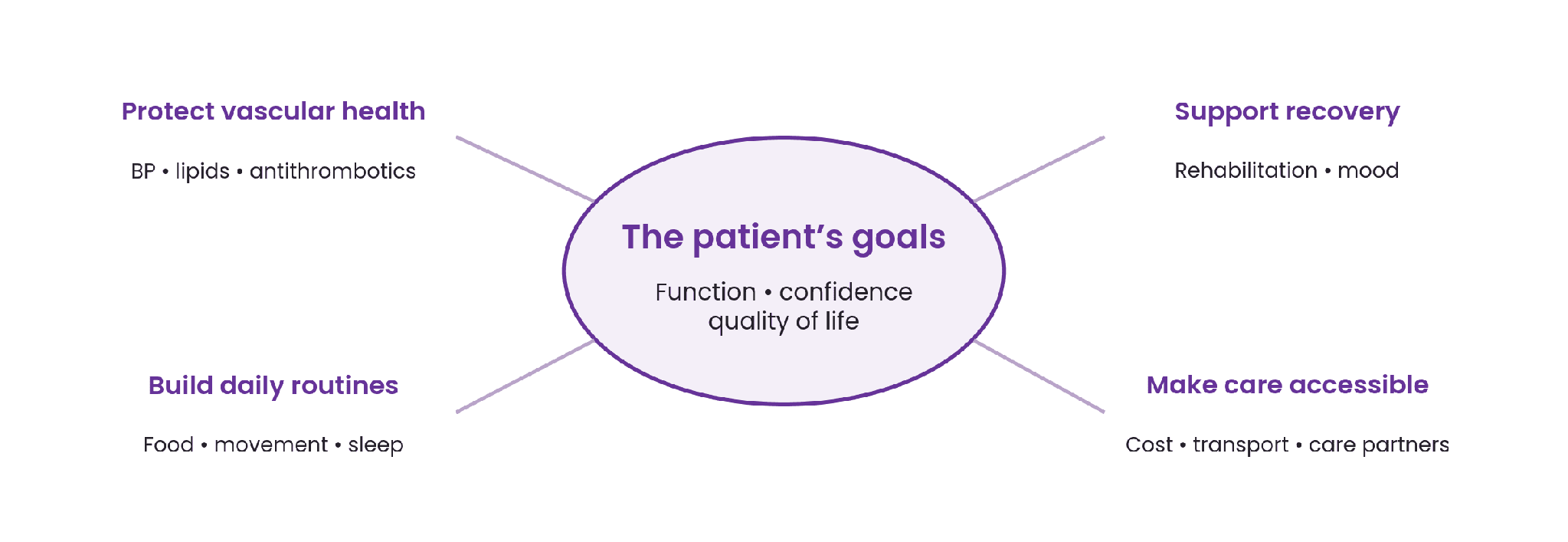
- Before a first event: The 2024 AHA/ASA Primary Stroke Prevention Guideline integrates vascular health with social conditions and life-stage risks. Address hypertension, diabetes, lipids, tobacco, activity, diet, and AF within routine care. The AHA PREVENT calculator can support ASCVD risk discussions in eligible adults without known ASCVD; aspirin is not routine primary stroke prevention.
- After ischemic stroke or TIA: For most patients with hypertension, a long-term BP goal <130/80 mm Hg is appropriate, individualized to tolerance. Use maximally tolerated lipid therapy for atherosclerotic disease; the 2026 ACC/AHA Dyslipidemia Guideline sets LDL-C <55 mg/dL for very-high-risk ASCVD. Individualize diabetes treatment and make medication access part of the plan.
- Make daily changes feasible: Adapt Mediterranean-style eating, smoking cessation support, reduced alcohol exposure, and movement to budget, swallowing safety, mobility, and fatigue. Connect activity goals with rehabilitation rather than adding a separate exercise burden.
Recovery and follow-up
The 2026 AHA/ASA Rehabilitation and Recovery Guideline supports coordinated therapy, reassessment, mental-health care, and care-partner training. Assign responsibility for pending workup, refills, DAPT stop dates, anticoagulant safety, and rehabilitation access. Use ASA Life After Stroke resources and ASA B.E. F.A.S.T. resources to support recovery and an emergency action plan.
Health Equity
Reduce barriers across the stroke pathway
Stroke inequities reflect differences in exposure to vascular risks and access to timely diagnosis, treatment, and recovery services. A sustainable plan addresses these barriers without treating race or ethnicity as a biological explanation for unequal care.
- Emergency access: Use interpreters, accessible symptom education, and consistent stroke activation criteria. Regional transfer pathways and telestroke can expand specialist access in rural and lower-resource settings.
- Communication and recovery: Adapt education for aphasia, cognitive or visual impairment, and preferred language. Include care partners with the patient’s consent; use teach-back and accessible print or audio options.
- Continuity: Coordinate medication coverage, transportation, therapy access, and follow-up before discharge. Offer telehealth when useful while retaining options for patients without reliable technology.
- System improvement: Use existing quality data to identify differences in treatment times, reperfusion, rehabilitation referrals, and follow-up by language, insurance, race/ethnicity, and geography.
Acronyms & Glossary
Term | Meaning |
|---|---|
TIA risk score: age, blood pressure, clinical features, duration, and diabetes | |
AF / ASCVD | Atrial fibrillation / atherosclerotic cardiovascular disease |
CTA / MRA | CT angiography / MR angiography |
DAPT / DOAC | Dual antiplatelet therapy / direct oral anticoagulant |
DWI | Diffusion-weighted MRI imaging |
ESUS | Embolic stroke of undetermined source |
ICH / SAH | Intracerebral / subarachnoid hemorrhage |
LVO / NIHSS | Large-vessel occlusion / NIH Stroke Scale |
PFO | Patent foramen ovale |
TIA / TOAST | Transient ischemic attack / Trial of ORG 10172 in Acute Stroke Treatment classification |
VTE | Venous thromboembolism |