

Blood Clots and the FITT Principles for Exercise
Read the FITT infographic+
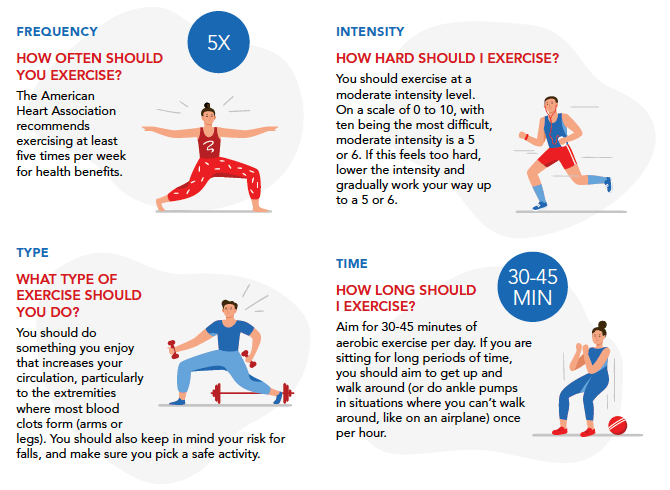
FREQUENCY
HOW OFTEN SHOULD YOU EXERCISE?
5X
The American Heart Association recommends exercising at least five times per week for health benefits.
INTENSITY
HOW HARD SHOULD I EXERCISE?
You should exercise at a moderate intensity level. On a scale of 0 to 10, with ten being the most difficult, moderate intensity is a 5 or 6. If this feels too hard, lower the intensity and gradually work your way up to a 5 or 6.
TYPE
WHAT TYPE OF EXERCISE SHOULD YOU DO?
You should do something you enjoy that increases your circulation, particularly to the extremities where most blood clots form (arms or legs). You should also keep in mind your risk for falls, and make sure you pick a safe activity.
TIME
HOW LONG SHOULD I EXERCISE?
30-45 MIN
Aim for 30-45 minutes of aerobic exercise per day. If you are sitting for long periods of time, you should aim to get up and walk around (or do ankle pumps in situations when you can’t walk around, like on an airplane) once per hour.
POST-BLOOD CLOT EXERCISE PRO TIPS
Dr. Ellen Hillegass, physical therapist, board certified in cardiovascular and pulmonary clinical specialty recommends the following:
Read the exercise pro tips+
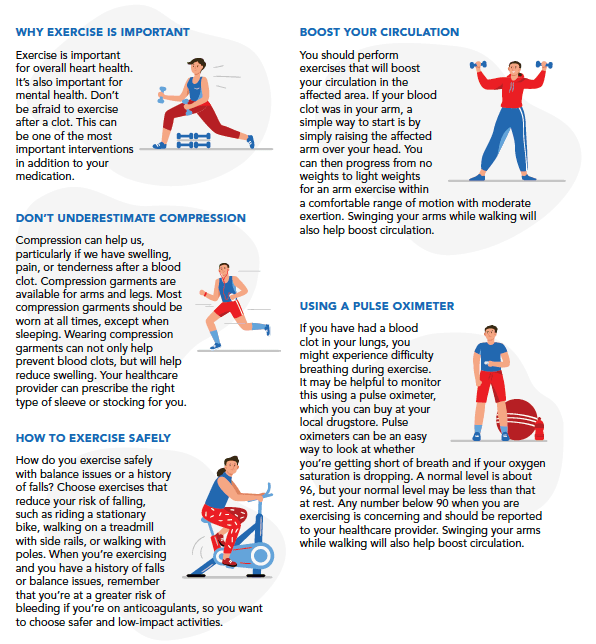
WHY EXERCISE IS IMPORTANT
Exercise is important for overall heart health. It’s also important for mental health. Don’t be afraid to exercise after a clot. This can be one of the most important interventions in addition to your medication.
DON’T UNDERESTIMATE COMPRESSION
Compression can help us, particularly if we have swelling, pain, or tenderness after a blood clot. Compression garments are available for arms and legs. Most compression garments should be worn at all times, except when sleeping. Wearing compression garments can not only help prevent blood clots, but will help reduce swelling. Your healthcare provider can prescribe the right type of sleeve or stocking for you.
HOW TO EXERCISE SAFELY
How do you exercise safely with balance issues or a history of falls? Choose exercises that reduce your risk of falling, such as riding a stationary bike, walking on a treadmill with side rails, or walking with poles. When you’re exercising and you have a history of falls or balance issues, remember that you’re at a greater risk of bleeding if you’re on anticoagulants, so you want to choose safer and low-impact activities.
BOOST YOUR CIRCULATION
You should perform exercises that will boost your circulation in the affected area. If your blood clot was in your arm, a simple way to start is by simply raising the affected arm over your head. You can then progress from no weights to light weights for an easier exercise within a comfortable range of motion with moderate exertion. Swinging your arms while walking will also help boost circulation.
USING A PULSE OXIMETER
If you have had a blood clot in your lungs, you might experience difficulty breathing during exercise. It may be helpful to monitor this using a pulse oximeter, which you can buy at your local drugstore. Pulse oximeters can be an easy way to look at whether you’re getting short of breath and if your oxygen saturation is dropping. A normal level is about 96, but your normal level may be less than that at rest. Any number below 90 when you are exercising is concerning and should be reported to your healthcare provider. Swinging your arms while walking will also help boost circulation.
Keep reading
 Blood Clots
I’ve been prescribed a blood thinner – now what?
An anticoagulant (often called a “blood thinner”) is a medication that’s used to treat and prevent blood clots.
Read Blood Clots
Anticoagulant Comparison Chart
Your healthcare provider may prescribe an anticoagulant (sometimes called a blood thinner) after you have a blood clot.
Read Blood Clots
Does Flying Increase My Risk for a Clot?
Long-distance travel may raise your stress level, but can it also raise your risk of getting a blood clot?
Read