

Is Sitting the New Smoking?
You might have heard that “sitting is the new smoking,” a phrase intended to draw attention to the health risks of both sitting and smoking. By now, we all know that smoking is very bad for you, but not everyone may be aware of how dangerous sitting may be. Many health experts are hoping to change that.
Is sitting really as bad as smoking? How bad is sitting for your health? Perhaps more importantly, what can you do to reduce your risk?
THE HEALTH RISKS OF SITTING
For the purposes of this discussion, “sitting” doesn’t simply mean assuming a sitting position. Instead, we’re referring to sedentary behavior – long periods of time when you move minimally, or not at all. Many jobs, especially office jobs, involve sitting for most of the workday. Many people also spend most of their leisure time sitting while they watch TV, look at their phones, or read. (You might actually be lying down for some of that time, but it’s the inactivity that’s the important factor, not the sitting position itself.)
A 2018 study found that sitting for more than eight hours per day was associated with the following increases in risk:
- Type-2 diabetes
- Cancer
- Heart disease or stroke
- Depression
- Overall risk of death
HOW DOES SITTING CAUSE HARM?
Sitting raises the risk of clots in both the veins and the arteries. A clot in a vein usually occurs in the lower legs (known as deep vein thrombosis or DVT), but can travel to the lungs and cause a life-threatening pulmonary embolism (PE). A clot in an artery can block the blood flow to an organ, leading to very serious health issues like heart attack or a stroke.
When you’re sedentary, blood flow slows down. Blood tends to pool, especially in the veins, and veins rely on the movements of surrounding muscles to push blood through. Stagnant blood has a strong tendency to clot. The longer you spend without moving, the greater the chance that a clot will form.
Physical inactivity can also contribute to the buildup of fat deposits in the blood vessel walls. These fatty deposits can increase the risk of heart attack and stroke.
Weight gain may also help to explain the association between sitting and health risks, and some experts believe that this is the main driver of the link. People who are physically inactive have a much higher risk of being overweight or obese, which in turn raises the risk for several health problems. The accumulation of excess fat tissue, particularly in the organs, causes chronic inflammation throughout the body, raising the risk of cancer and other diseases.
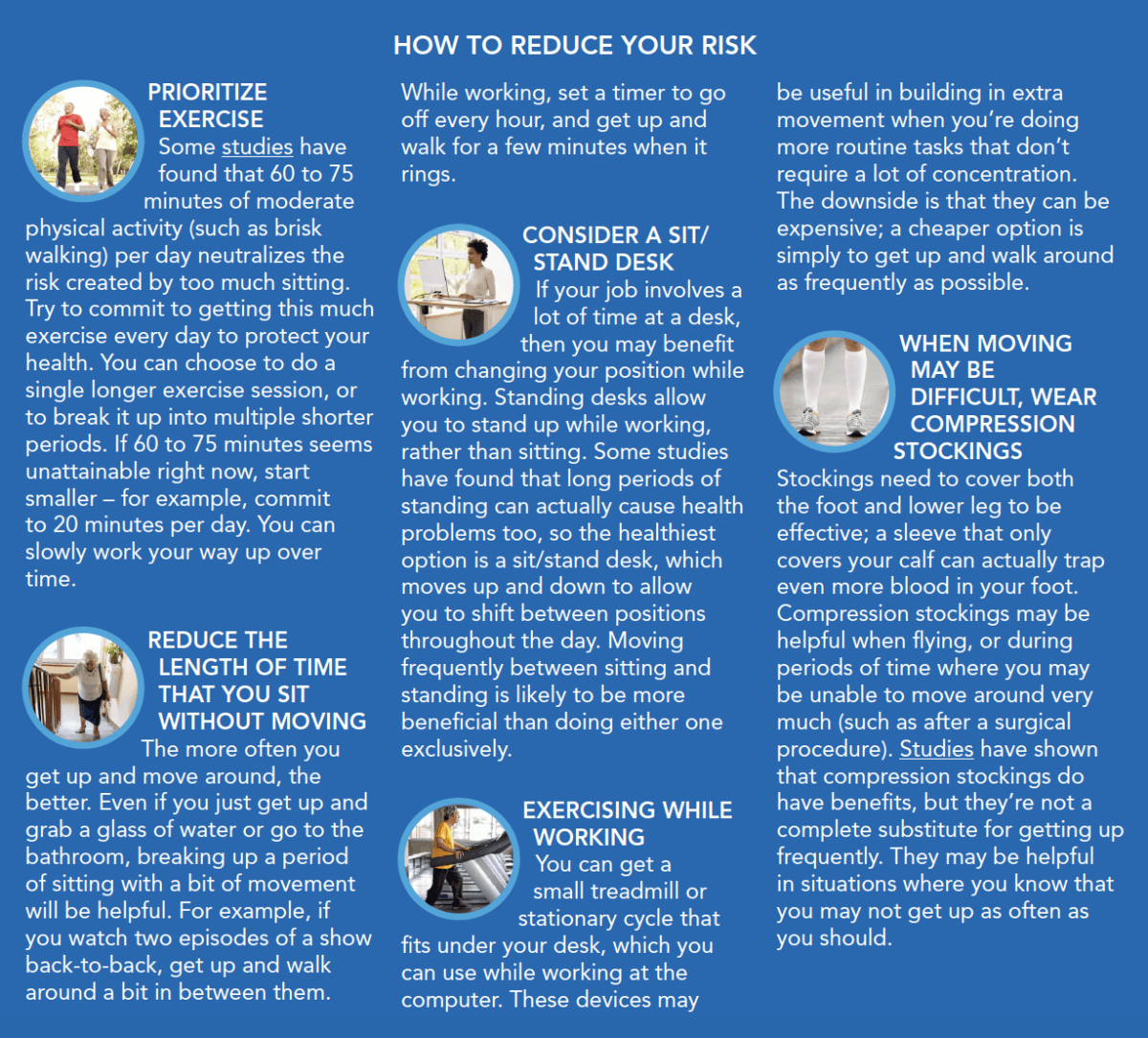
HOW TO REDUCE YOUR RISK+
PRIORITIZE EXERCISE
Some studies have found that 60 to 75 minutes of moderate physical activity (such as brisk walking) per day neutralizes the risk created by too much sitting. Try to commit to getting this much exercise every day to protect your health. You can choose to do a single longer exercise session, or to break it up into multiple shorter periods. If 60 to 75 minutes seems unattainable right now, start smaller – for example, commit to 20 minutes per day. You can slowly work your way up over time.
REDUCE THE LENGTH OF TIME THAT YOU SIT WITHOUT MOVING
The more often you get up and move around, the better. Even if you just get up and grab a glass of water or go to the bathroom, breaking up a period of sitting with a bit of movement will be helpful. For example, if you watch two episodes of a show back-to-back, get up and walk around a bit in between them.
While working, set a timer to go off every hour, and get up and walk for a few minutes when it rings.
CONSIDER A SIT/STAND DESK
If your job involves spending a lot of time at a desk, then you may benefit from changing your position while working. Standing desks allow people to stand up while working, rather than sitting. Some studies have found that long periods of standing can actually cause health problems too, so the healthiest option is a sit/stand desk, which moves up and down to allow you to shift between positions throughout the day. Moving frequently between sitting and standing is likely to be more beneficial than doing either one exclusively.
EXERCISING WHILE WORKING
You can get a small treadmill or stationary cycle that fits under your desk, which you can use while working at the computer. These devices may be useful in building in extra movement while you’re doing more routine tasks that don’t require a lot of concentration. The downside is that they can be expensive; a cheaper option is simply to get up and walk around as frequently as possible.
WHEN MOVING MAY BE DIFFICULT, WEAR COMPRESSION STOCKINGS
Stockings need to cover both the foot and lower leg to be effective; a sleeve that only covers your calf can actually trap even more blood in your foot. Compression stockings may be helpful when flying, or during periods of time where you may be unable to move around very much (such as after a surgical procedure). Studies have shown that compression stockings do have benefits, but they’re not a complete substitute for getting up frequently. They may be helpful in situations where you know that you may not get up as often as you should.
COMPARING SMOKING WITH SITTING
It’s important to point out that while sitting and smoking are both risky for your health, smoking is significantly more dangerous. The dangers of smoking should not be minimized. Smoking dramatically increases your risk for both blood clots and many other serious health problems.
A 2018 paper looked at the risks of both smoking and sitting and found that sitting increases the risk of death by 22%, while smoking increases it by 180% – meaning that smoking nearly triples the risk of death. For heavy smokers (two packs a day), the risk of death is more than five times higher than for a nonsmoker.
The truth is that sitting and smoking are not equivalent behaviors – smoking is worse for your health, although sitting is bad too. If you smoke and are sedentary, quitting smoking may have greater benefits to your health – but becoming more physically active is also important, and the benefits of this should not be minimized.
That’s what the phrase “sitting is the new smoking” means. It aims to highlight a health threat that many people are unaware of, and to convince at least a few of them to sit less. The more movement you can build into your day, the lower your risk of health issues – including blood clots.
REFERENCES3 sources+
- Annals of Internal Medicine: Sedentary Time and Its Association With Risk for Disease Incidence, Mortality, and Hospitalization in Adults
- The Lancet: Does physical activity attenuate, or even eliminate, the detrimental association of sitting time with mortality? A harmonised meta-analysis of data from more than 1 million men and women
- National Library of Medicine: Effects of compression stockings on lower-limb venous and arterial system responses to prolonged sitting: A randomized cross-over trial
Originally published in The Beat, October 2022.
Keep reading
 Fitness & Being Active
Physical Therapy: A Role in Blood Clot Management
We often hear that physical therapy (PT) helps patients get back on their feet after an injury, surgery, stroke, or other medical issue.
Read Fitness & Being Active
Blood Clots and the FITT Principles for Exercise
Dr. Ellen Hillegass, physical therapist, board certified in cardiovascular and pulmonary clinical specialty recommends the following:
Read Fitness & Being Active
Wearable Devices and Heart Health: What’s The Buzz?
Wearable devices (smartwatches and fitness trackers) can tell us a lot about ourselves, from how many steps we’ve taken in a day to how much water we’ve had and how many calories we’ve burned. But can they accurately flag heart abnormalities? We spoke with Dr. Daniel Yazdi from Brigham and Women’s Hospital to find out more.
Read