
Atherosclerotic Cardiovascular Disease (ASCVD)
Atherosclerotic Cardiovascular Disease (ASCVD)
Treatment
On this page
Secondary prevention: Lower LDL-C in established ASCVD
Use a high-intensity or maximally tolerated statin, adding nonstatin therapy when needed. Assess both the percentage reduction and the level reached.
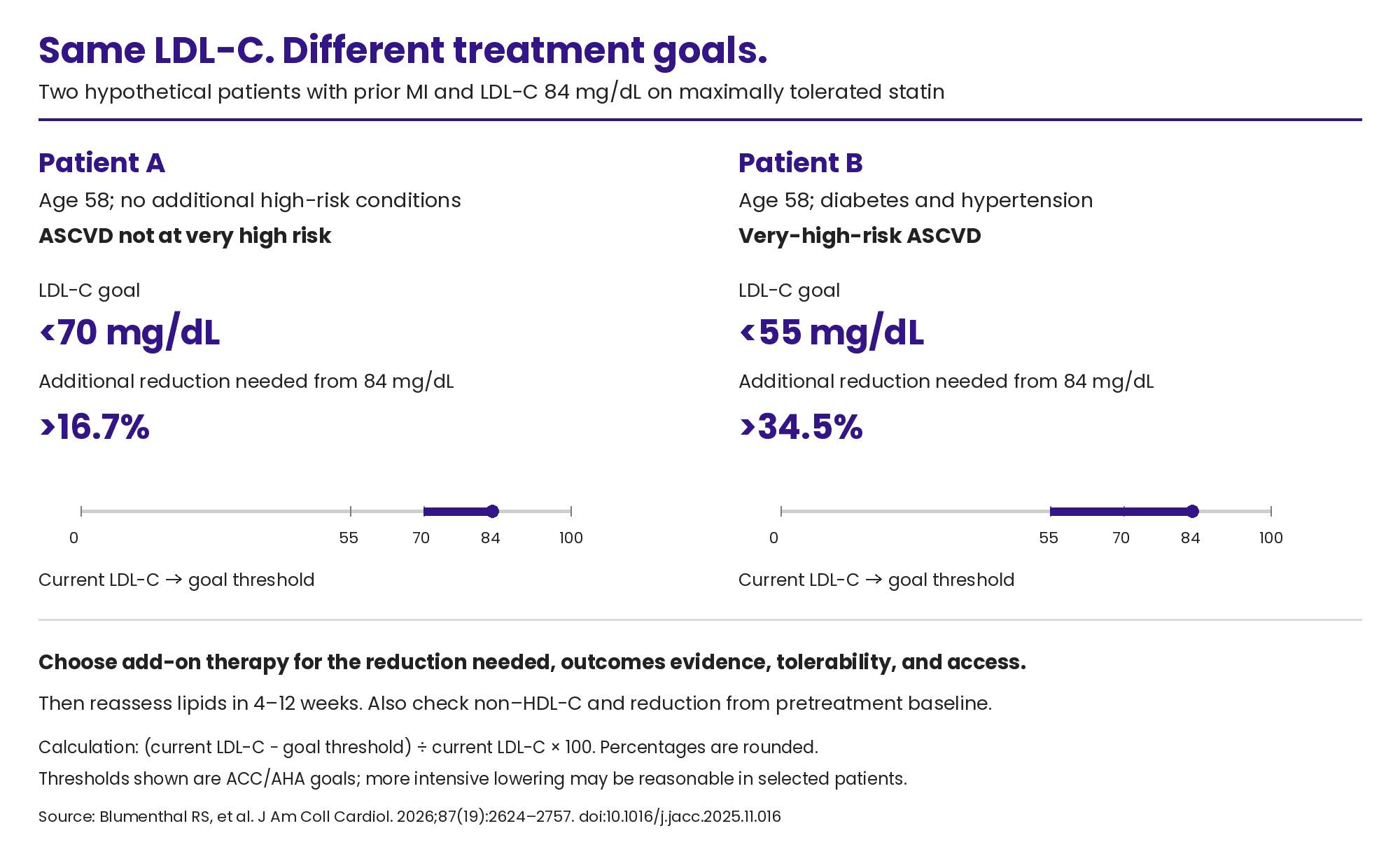
The 2026 ACC/AHA multisociety dyslipidemia guideline sets lipid goals for established clinical ASCVD based on whether the patient meets very-high-risk criteria. Use these goals to assess response to maximally tolerated statin therapy and the need for additional lipid lowering.
Clinical ASCVD category | LDL-C goal | Non–HDL-C goal |
|---|---|---|
Not at very high risk | <70 mg/dL | <100 mg/dL |
Very high risk | <55 mg/dL | <85 mg/dL |
Who qualifies as “very high risk”?
Patients with multiple major ASCVD events, or one major event plus multiple high-risk conditions.
Major ASCVD events include:
- ACS within the past 12 months
- Prior MI, excluding the recent ACS already counted
- Ischemic stroke
- Symptomatic PAD
High-risk conditions include:
- Age >65 years
- Prior coronary bypass surgery or percutaneous coronary intervention (PCI) outside the major ASCVD event already counted
- Current smoking
- Diabetes
- Hypertension
- History of congestive heart failure
- LDL-C >100 mg/dL despite maximally tolerated statin therapy plus ezetimibe
Example: a patient with a prior MI, diabetes, and hypertension qualifies as very high risk. Coronary revascularization alone is a high-risk condition, rather than a major event in this classification.
When to add nonstatin therapy
In established ASCVD, add therapy when maximally tolerated statin treatment doesn’t achieve the patient’s lipid goals, generally LDL-C <70 mg/dL, or <55 mg/dL for very-high-risk patients. Confirm adherence and assess the additional reduction needed.
- Very-high-risk ASCVD: Add ezetimibe and/or a PCSK9 monoclonal antibody (evolocumab or alirocumab) to reach goal. Bempedoic acid is another guideline-supported option when additional lowering is needed.
- ASCVD not at very high risk: Ezetimibe, a PCSK9 monoclonal antibody, or bempedoic acid are reasonable options. Choose based on the reduction needed, patient preference, tolerability, and access.
There’s no requirement to try every agent in order. Some patients need combination therapy to reach goal.
Where inclisiran fits
Check response and tolerability
- Evaluate reported statin symptoms, interactions, and other possible causes; adjust treatment rather than leaving LDL-C unaddressed.
- Repeat a lipid panel 4–12 weeks after starting or adjusting therapy, then every 6–12 months.
- Assign responsibility among the medical team/support staff for repeat testing and treatment follow-up.
Manage coronary symptoms and prevent another event
Antiplatelet therapy
- Low-dose aspirin (75–100 mg daily, typically 81 mg in the U.S.) is recommended for chronic coronary disease when there’s no indication for oral anticoagulation.
- After ACS, aspirin plus a P2Y12 inhibitor (e.g., clopidogrel, prasugrel, or ticagrelor) for at least 12 months is the default for patients without high bleeding risk. Agent selection depends on the clinical setting and contraindications.
- Bleeding risk, PCI history, and concurrent anticoagulation can change the regimen and duration. Document the indication and planned duration at transitions of care.
Angina and revascularization
- Treat angina alongside cardiovascular risk. Consider revascularization when symptoms persist despite medical therapy, or when coronary anatomy indicates a potential survival benefit from intervention.
- Revascularization doesn’t replace preventive care. Refer eligible patients to cardiac rehab.
Review beta-blocker indications
If a beta-blocker was started after MI, it’s reasonable to reassess its use beyond one year when there’s no history of—or current—left ventricular ejection fraction (LVEF) ≤50%, angina, arrhythmia, or uncontrolled hypertension. In coronary disease without prior MI or LVEF ≤50%, beta-blockers don’t reduce major cardiovascular events in the absence of another indication. These recommendations support reviewing the indication, rather than automatically stopping treatment.
Resources & References
Guidelines
Full guidelines, practical tools, and supporting publications are listed separately below.
- 2026 ACC/AHA Dyslipidemia Guideline
- 2023 AHA/ACC Chronic Coronary Disease Guideline
- 2025 ACC/AHA Acute Coronary Syndromes Guideline
- 2025 AHA/ACC High Blood Pressure Guideline
- ADA Standards of Care in Diabetes—2026: Cardiovascular Disease and Risk Management
- 2021 AHA/ACC Chest Pain Guideline—Executive Summary
- 2019 ACC/AHA Primary Prevention Guideline—aspirin and lifestyle guidance
*For lipid management and risk estimation, use the 2026 dyslipidemia guideline rather than the older lipid recommendations in the 2019 prevention guideline.
Additional guidance & clinical tools
- 2026 Dyslipidemia Guideline-at-a-Glance—implementation summary
- 2026 ACC Antiplatelet Therapy Scientific Statement
- 2025 ESC/EAS Focused Update on Dyslipidaemias
- 2025 AACE Dyslipidemia Consensus Algorithm
- AHA PREVENT calculator
- Vasculearn Network Lp(a) Clinician Toolkit
- ACC Lipid Manager
- JACC Chest Pain Interactive Tool—evaluation and testing pathways
- 2022 ACC Acute Chest Pain Decision Pathway—emergency department evaluation and disposition
- ADA 2026 Pharmacologic Treatment Tables—agent-specific cardiovascular and kidney benefits
- AHA scientific statement on implementing prevention to eliminate health care inequities
References
1. Blumenthal RS, Morris PB, Gaudino M, et al. J Am Coll Cardiol. 2026;87(19):2624-2757. doi:10.1016/j.jacc.2025.11.016
2. Virani SS, Newby LK, Arnold SV, et al. J Am Coll Cardiol. 2023;82(9):833-955. doi:10.1016/j.jacc.2023.04.003
3. Rao SV, O’Donoghue ML, Ruel M, et al. J Am Coll Cardiol. 2025;85(22):2135-2237. doi:10.1016/j.jacc.2024.11.009
4. Gulati M, Levy PD, Mukherjee D, et al. J Am Coll Cardiol. 2021;78(22):2218-2261. doi:10.1016/j.jacc.2021.07.052
5. Mach F, Koskinas KC, Roeters van Lennep JE, et al. Eur Heart J. 2025;46(42):4359-4378. doi:10.1093/eurheartj/ehaf190
6. Patel SB, Belalcazar LM, Afreen S, et al. Endocr Pract. 2025;31(10):1207-1238. doi:10.1016/j.eprac.2025.07.014
7. Wiggins BS, Barac A, Benziger CP, et al. J Am Coll Cardiol. 2026;87(19):2617-2623. doi:10.1016/j.jacc.2026.02.4872
8. Lee YJ, Lee SJ, Kim JW, et al. N Engl J Med. 2026;394(14):1365-1375. doi:10.1056/NEJMoa2600283
9. Kumbhani DJ, Gibson CM, Kinlay S, et al. J Am Coll Cardiol. 2026;88(11):1284-1313. doi:10.1016/j.jacc.2026.05.037
10. Jones DW, Ferdinand KC, Taler SJ, et al. J Am Coll Cardiol. 2025;86(18):1567-1678. doi:10.1016/j.jacc.2025.05.007
11. Arnett DK, Blumenthal RS, Albert MA, et al. J Am Coll Cardiol. 2019;74(10):e177-e232. doi:10.1016/j.jacc.2019.03.010
12. American Diabetes Association Professional Practice Committee for Diabetes. Diabetes Care. 2026;49(suppl 1):S216-S245. doi:10.2337/dc26-S010
13. Agarwala A, Patel J, Stephens J, et al. Circulation. 2023;148(15):1183-1193. doi:10.1161/CIR.0000000000001171
There’s a place for
your voice here.
Patients and caregivers bring their questions and lived experiences. You bring a perspective that can make a difference. Meet the people behind the questions—and the peers who share your work.